
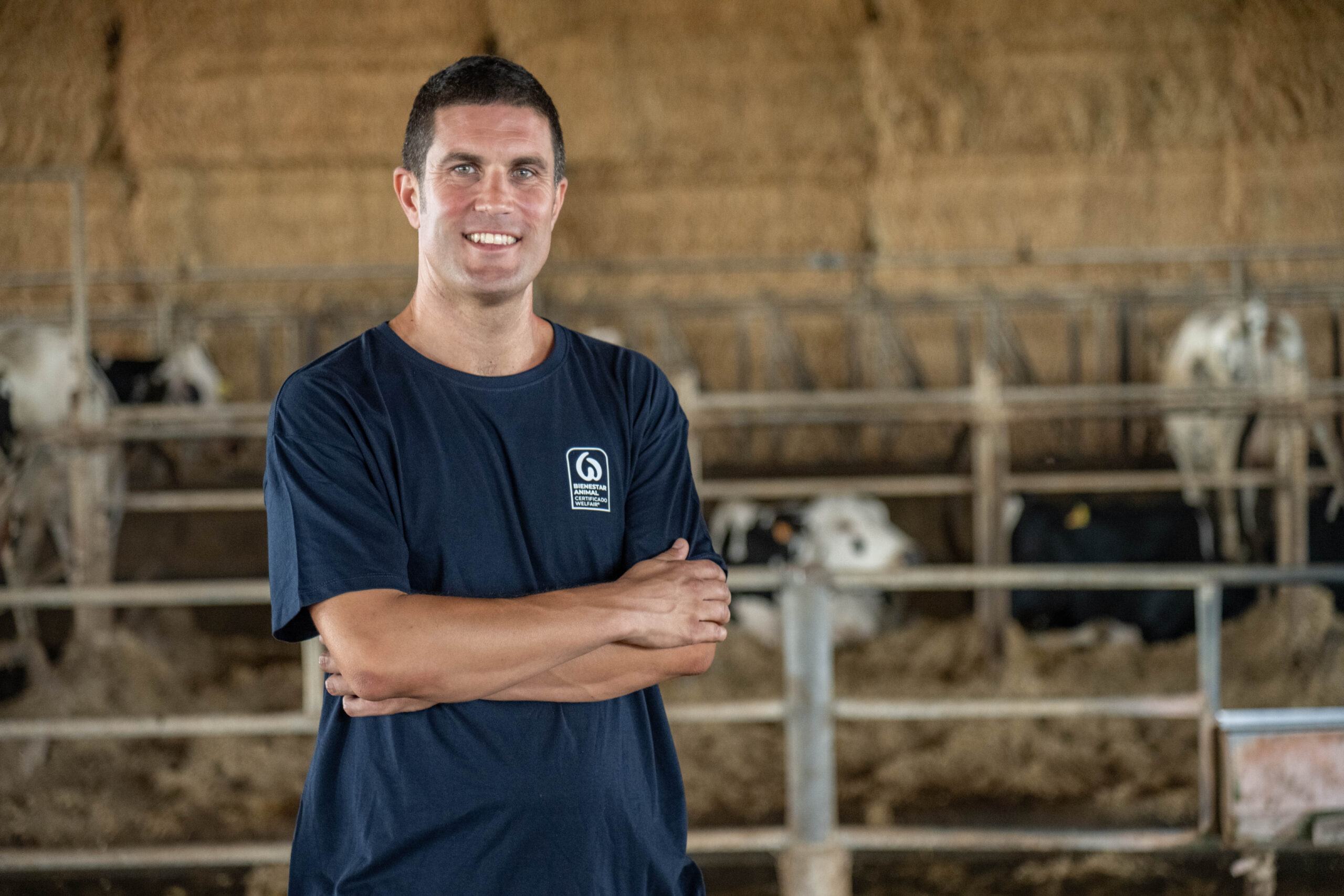
How an animal welfare audit works: the experience of the technical coordinator of Welfair®
Animal welfare has become one of the greatest challenges and, at the same time, one of the main opportunities for improvement in the agri-food sector. More and more companies are seeking tools that allow them to objectively assess the conditions in which animals live and move towards more responsible and transparent production models that are aligned with the expectations of consumers and markets. In this context, certification Welfair® plays a fundamental role, by offering an evaluation system based on scientific evidence and direct observation of animals.
Quim Pallisera understands this reality from multiple perspectives. A veterinarian by training and influenced from a young age by his father's profession, also a veterinarian, he began his professional career in the agri-food industry, where he was able to learn firsthand how the sector works and realize that there was still room to make further progress in animal welfare.
Driven by this concern, he joined IRTA and became part of the team that promoted the development of Welfair® since its inception. During the first few years, it conducted audits on farms and slaughterhouses, an experience that allowed it to understand firsthand the challenges, needs, and progress of certified companies. Subsequently, it assumed training and support roles for auditors, helping to ensure the consistent and rigorous application of assessment protocols.
After more than a decade involved with the project, he is currently Technical coordinator of the Certification Welfair®, a responsibility from which he ensures the technical coherence of the scheme, the training of the audit teams and the correct application of standards that are now a benchmark in animal welfare both in Spain and in other international markets.
We spoke with him about how an animal welfare audit is conducted, what aspects are evaluated, and how these tools contribute to driving real improvements throughout the food chain.
1. To begin, could you explain what your job as technical coordinator for animal welfare within the scheme entails? Welfair®?
As technical coordinator, my main responsibility is to ensure that the assessments are carried out correctly, following the Welfare Quality® and AWIN® scientific protocols, as well as the Prerequisites Welfair®, which include aspects such as legislation, biosafety and other technical criteria of the scheme.
This work is not limited to office supervision, but combines coordination with an active presence in the field. Participating in audits at farms and slaughterhouses provides firsthand knowledge of the sector's realities and offers an essential global perspective for decision-making.
Furthermore, this role has a strong training and mentoring component. Its functions include:
- participation in the initial training and calibration of auditors
- follow-up in field audits (both for authorization and supervision)
- resolving technical questions from auditors, certification bodies, and companies.
All of this with a clear objective: to ensure consistency and uniformity in the application of the scheme.
I also collaborate closely with the business development area, participating in company visits and contributing to the expansion of the certification into new international markets.
2. Audits are a key part of certification. How is an animal welfare audit conducted on a farm or in a slaughterhouse?
Audits typically begin early, between 8 and 9 a.m., and can last up to seven hours. The first step is to familiarize oneself with the farm: how many buildings there are, where the animals are kept, where the infirmaries are located, and how the different spaces are laid out. From there, the sampling plan is designed, determining which areas and animals will be evaluated.
For example, on a dairy farm with 100 or 200 animals, it would be impractical to inspect each one individually, so we work with representative groups that vary depending on the farm's size. This process involves observing indicators such as the time it takes for the animals to lie down, the presence of lameness, and interactions between them. Once the sampling is complete, we record the measurements on a field data sheet, which we then transfer to a spreadsheet to obtain the final scores. During the audit, we are usually accompanied by someone from the company's quality department, and sometimes even the farmer. At the end, we typically exchange impressions with both of them to share our overall assessment or address any questions they may have.
The process is structured in three main blocks:
- Evaluation of scientific protocols
The Welfare Quality® or AWIN® protocols are applied, depending on the species and the production phase.
The auditors combine:
- animal-based indicators, such as body condition or behavior
- indicators related to facilities and management
This evaluation results in a score from 0 to 100. To become certified, it is necessary to achieve at least 55 points, which guarantees a minimum level of animal welfare.
- Review of Prerequisites Welfair®
They include legislation, biosafety, and other technical criteria of the scheme.
All requirements are mandatory, but are classified as minor, major, and critical (KO) based on the consequences of non-compliance. This section assesses not only measures related to the animal, facilities, and handling, but also the documentation that verifies that processes are carried out correctly. - Final report and validation
Following the fieldwork, a comprehensive report is prepared, including the results of the protocols and the evaluation of the prerequisites. This report is reviewed by the certifying body's report reviewer, who is also a trainer. Welfair®, and only when everything meets the established standards is the decision made to issue the certificate.
Overall, it is a rigorous process that guarantees the reliability and credibility of the certification.
3. During an audit, what type of indicators or situations do you observe to assess animal welfare?
One of the distinguishing aspects of WelfairThe key difference is that the audits are based primarily on direct observation of the animals. In other words, not only are the facilities and procedures evaluated, but also the actual condition of the animals in their daily lives.
The indicators are organized around four principles:
Good nutrition
- body condition
- access to water
- fasting times
Good accommodation
- comfort of the environment
- Available space
- signs of heat stress
Good health
- wounds and injuries
- clinical signs
- Pain assessment and management
Appropriate behavior
- Social interactions
- expression of natural behaviors
- relationship with people
- emotional state
Taken together, these indicators provide a complete view of animal welfare, from both a physical and behavioral perspective.
4. Unlike other systems based primarily on facility requirements, Welfair® focuses on animal-based indicators. Why is it so important to observe animals directly?
In animal welfare there are two types of indicators: those based on facilities and management, and those based on the animal itself.
The first signs indicate the risk of problems arising. For example, poor soil conditions can increase the likelihood of injuries. However, only by directly observing the animals can you verify whether those injuries are actually occurring.
Animal-based indicators allow for the assessment of actual welfare status and provide much more accurate information. Furthermore, they offer two key advantages:
- They are more representative of the animal's reality
- They are comparable between countries and different production systems.
Although they require more time in the field and specialized personnel, these indicators allow for more objective assessments that are more aligned with reality. Furthermore, these indicators are specific to each species. For example, in laying hens, the condition of the plumage is evaluated, while in pigs, the presence of tail bites can be analyzed, and in cattle, aspects such as the time it takes the animal to lie down are considered. Each species exhibits different behaviors and needs, so direct observation allows the assessment to be adapted to its specific circumstances.
5. From your experience in audits, what aspects of animal welfare tend to generate the most challenges or areas for improvement in facilities?
The challenges vary depending on the degree of implementation of the certification:
The main challenge is continuous improvement, adapting to new demands and evolving in line with the prerequisites. Welfair®.
Start-up companies
The challenge is usually cultural rather than technical. Adapting to animal-based audits raises initial doubts, although it is generally valued positively for providing a more realistic perspective.
New international markets mean facing different production realities (climate, breeds, management systems). It requires adaptability without sacrificing technical rigor.
In all cases, animal welfare should be understood as a process of continuous improvement.
"The audit is not the end, but the starting point for generating real change.”
6. Audits are often thought of as merely a check. In practice, how do audits contribute to driving improvements in animal welfare within companies?
Audits are a key tool for continuous improvement.
They allow companies to:
- obtain an objective and external evaluation
- detect aspects that might go unnoticed
- set clear priorities
- plan data-driven improvements.
The audit is not the end, but the starting point for generating real changes.
7. Independence is one of the pillars of certification Welfair®. Why is it important that audits are carried out by independent certification bodies?
Independence ensures that evaluations are carried out objectively, transparently, and without conflicts of interest.
This builds trust:
- in the audited companies
- in consumers
- within the system itself.
In a field like animal welfare, credibility is fundamental.
“The audit is not the end, but the starting point for generating real change.”
8. From a technical point of view, what value does certification bring? Welfair® to companies in the food chain?
Welfair® offers a scientific, transparent and comparable assessment of animal welfare.
It allows companies to:
- to know the true condition of their animals
- Identify data-driven improvements
- working with homogeneous criteria
- align with international standards
- structure their biosecurity and management processes.
It is a key tool for differentiating oneself and anticipating market demands.
9. From your experience, what evolution have you observed in the sector in recent years with respect to animal welfare?
The evolution has been very significant.
Animal welfare has gone from being a legal requirement to becoming a strategic element. Furthermore, the sector has made progress in:
- professionalization
- technical knowledge
- focus on continuous improvement.
The most relevant change has been going from 'complying' to 'wanting to improve'.
10. Finally, what message would you give to companies that are considering animal welfare certification but haven't yet taken the step?
Certification is not just a seal, but an opportunity to better understand the real condition of the animals and improve production systems.
Although it may initially raise doubts, certified companies:
- improve their organization
- optimize handling
- gain efficiency
- They reinforce trust.
It is a step towards a more solid, professional model, prepared for the challenges of the future.